

Think about the last time you searched something in Arabic on Google.
Did you quickly find a clear, helpful answer?
Or did you open a few pages, feel confused, and leave without real clarity?
This happens more often than people admit.
Millions of Arabic speakers search online every single day. They are looking for simple explanations, practical steps, and honest guidance in their own language. Yet much of the Arabic content available today feels copied, poorly translated, or written without real experience.
That gap is real.
And that gap is an opportunity.
At some point, many people have this thought: “I could explain this much better.”
If you have ever felt that way, it is not random. It means you already understand what readers are missing.
The good news is this:
You do not need technical skills.
You do not need expensive tools.
You do not need to be perfect from day one.
What you need is a clear direction, a simple setup, and the willingness to help people with honest Arabic content that actually makes sense.
This step by step guide will walk you through the entire process. You will learn how to start an Arabic blog from scratch, choose the right niche, set everything up correctly, write content people trust, rank on Google, and slowly turn your blog into something valuable and long lasting.
We will take it one step at a time.
No pressure.
No confusion.
No shortcuts.
Just a clear path to starting your Arabic blog the right way.
Let’s begin.
Table of Contents
Why Starting a Blog in Arabic is a Smart Opportunity in 2026?
Many Arabic searches on Google still lack clear and practical answers, which creates a strong opportunity for new bloggers. With over 400 million Arabic speakers and lower competition in many niches, blogs written in native Arabic build trust and engage readers more effectively. Google rewards helpful, easy to understand content, making growth and monetization more achievable.
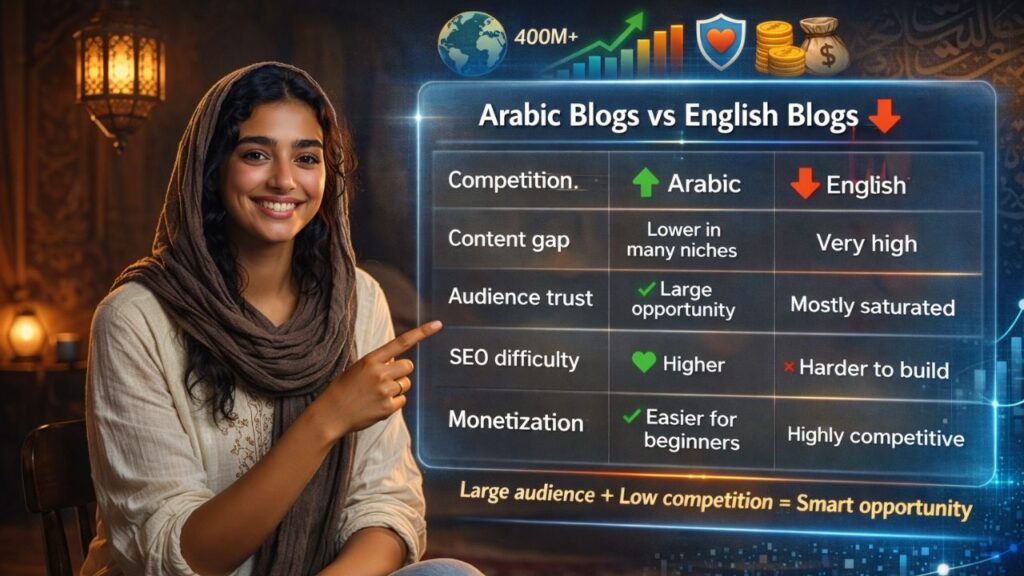
Why Arabic Blogging Makes Sense
- Large Arabic speaking audience with growing online activity
- Fewer high quality Arabic blogs than English
- Strong demand for clear, local explanations
- Higher trust with native language content
- Better engagement and repeat visits
- Growing interest from regional advertisers
Arabic vs English Blogging (Quick Comparison)
| Factor | Arabic Blogs | English Blogs |
| Competition | Lower in many niches | Very high |
| Content gap | Large opportunity | Mostly saturated |
| Audience trust | Higher | Harder to build |
| SEO difficulty | Easier for beginners | Tough |
| Monetization | Growing regional demand | Highly competitive |
This balance of demand, trust, and lower competition makes Arabic blogging a smart and realistic choice.
Essential Requirements to Start a Blog in Arabic 2026?
Starting an Arabic blog does not require many tools, but it does require the right basics. When you set things correctly from the beginning, you avoid confusion, technical issues, and wasted time later. The main focus should always be clarity, website speed, and a smooth user experience. A strong foundation makes growth easier and keeps your blog stable as it grows.
What You Actually Need to Start an Arabic Blog
- Clear goal and direction: Know why you are starting and who you want to help. Focused blogs grow faster.
- Defined niche and audience: One main topic and one type of reader builds stronger trust.
- Brandable domain name: Easy to remember, easy to pronounce in Arabic, and flexible for growth.
- Fast WordPress hosting: Reliable hosting with NVMe storage improves speed and SEO.
- Clean and secure WordPress setup: Only essential plugins to keep the site lightweight.
- Simple SEO and content routine: A repeatable process helps you stay consistent.
Why These Basics Matter
| Requirement | Why It’s Important |
| Clear niche | Builds trust and loyal readers |
| Good domain name | Easy recall and branding |
| Fast hosting | Better user experience and SEO |
| Clean setup | Fewer issues, smoother growth |
| Simple workflow | Helps maintain consistency |
These essentials act as the foundation of your blog. When the base is strong, long term growth becomes much easier and more reliable.
Choosing a Perfect Domain Name for Your Arabic Blog
Your domain name is more than just a web address.
It is the identity of your blog, the name people remember, type into Google, and share with others.
For Arabic blogs, choosing the right domain name is even more important. Arabic pronunciation, spelling, and dialects can change from region to region, so your domain should feel natural, clear, and trustworthy the moment someone sees it.
A good domain name should be:
- Short and easy to remember
- Simple to pronounce in Arabic
- Clean and professional
- Flexible enough to grow with your blog
Avoid using numbers, hyphens, or long keyword filled names. These make domains harder to remember and look less trustworthy over time. Instead, focus on a brandable name—something that sounds natural and still makes sense even if your blog expands into new topics later.
Whenever possible, choose a .com domain. It is the most trusted and widely recognized extension worldwide. If your blog targets a specific country, local extensions such as .sa, .ae, or .eg can also work well and help with local branding.
Best Places to Buy a Domain
You can buy your domain from many reliable providers. Some beginner friendly and trusted options include:
- YouStable – Affordable, beginner friendly, and very easy to manage
- Namecheap – Popular for low prices and simple dashboard
- GoDaddy – Well known, but pricing can be higher
- Google Domains – Clean interface and reliable service
- Dynadot – Good pricing and strong domain tools
- Porkbun – Transparent pricing with no hidden fees
- Hostinger – Often bundles domain with hosting
For beginners, choosing a provider that is easy to manage and budget friendly makes a big difference. Platforms like YouStable help new bloggers get online quickly, manage everything from one dashboard, and avoid unnecessary confusion during the early stages.
A strong domain name sets the tone for your entire blog. Take a little time to choose wisely, it’s a decision that supports your blog for years to come.
Free vs Paid Hosting for Arabic Blogs – Which One is Better?
Free hosting often looks appealing when you are starting out, but it usually creates more limitations than benefits. Most free hosting platforms suffer from slow loading speeds, frequent downtime, limited server resources, and forced advertisements.
You also get very little control over performance or settings, which results in poor Core Web Vitals. Because of this, Google is less likely to trust the site, and visitors often leave quickly. Getting approval for AdSense or other partner programs also becomes difficult.
Paid hosting provides a much stronger and more reliable foundation for an Arabic blog. Hosting that uses NVMe SSD storage and LiteSpeed servers loads pages significantly faster and keeps the site stable. This directly improves key SEO metrics such as LCP, CLS, and INP, which helps rankings and user experience.
Free vs Paid Hosting Comparison
| Feature | Free Hosting | Paid Hosting |
| Website speed | Slow | Fast |
| Uptime & stability | Unreliable | Stable |
| Core Web Vitals | Poor | Optimized |
| AdSense approval | Difficult | Easier |
| Control & flexibility | Very limited | Full control |
| Security & backups | Basic or none | SSL, backups, support |
In simple terms, free hosting slows growth and limits trust. Paid hosting supports long term success, making it the better choice for serious Arabic bloggers.
Best WordPress Hosting Setup for Arabic Blogs in 2026
To run an Arabic blog smoothly, your WordPress hosting setup should focus on speed, stability, and security. You don’t need advanced technical knowledge, but choosing the right hosting features from the start makes a big difference in performance, user experience, and search visibility.
A reliable WordPress hosting setup for Arabic blogs should include:
- NVMe SSD storage to ensure faster page loading and efficient handling of WordPress databases
- LiteSpeed or OpenLiteSpeed servers with built in caching to improve Core Web Vitals
- Data centers close to your audience, such as the Middle East or nearby regions, for faster local loading
- Global CDN support like Cloudflare to deliver content quickly across countries and add extra security
- Free SSL certificate to keep the site secure and build trust with users and search engines
- Daily backups and basic security protection to prevent data loss and handle common threats
- Staging environment to safely test themes, plugins, and updates before going live
When these essentials are in place, your Arabic blog remains fast, secure, and stable. This setup reduces technical stress and allows you to focus on writing helpful content and growing your blog with confidence.
How to Set Up Fast WordPress Hosting for an Arabic Blog (Step-by-Step)
Setting up WordPress hosting may sound technical at first, but in practice it’s a simple and logical process. If you follow the steps in the right order, you can create a fast, stable, and secure foundation for your Arabic blog without any technical background. The main goal here is speed, reliability, and proper RTL support so both users and Google have a smooth experience.
Step 1: Choose a Reliable WordPress Hosting Provider
This is the most important step because your hosting directly affects page speed, uptime, security, and Google rankings. A good WordPress hosting provider should offer fast server performance, stable uptime, WordPress optimized support, and a beginner friendly control panel. Providers such as YouStable, Namecheap, Bluehost, SiteGround, and Hostinger are commonly used by bloggers.
Many beginners choose YouStable because it is optimized for WordPress, easy to manage, and often includes a free domain for one year, which helps reduce starting costs and keeps everything in one dashboard. Always choose a provider that fits your budget and allows smooth scaling later.
Step 2: Buy Hosting and Connect Your Domain
Once you purchase hosting, add your domain inside the hosting control panel. If your domain is registered with a different provider, you will need to update the nameservers given by your host. This process is usually guided step by step and may take a few minutes to a few hours to fully connect.
Step 3: Install WordPress Using One Click Setup
Most hosting providers offer a one click WordPress installer. Use it to install WordPress, enable SSL (HTTPS) immediately, and set a strong username and password. Avoid using “admin” as the username to keep your site more secure.
Step 4: Configure WordPress for Arabic Language
After logging into WordPress, go to Settings → General and select Arabic (العربية) as the site language. Save the changes, and your dashboard will automatically switch to RTL layout, making it easier to manage Arabic content.
Step 5: Enable Speed and Safety Essentials
Before publishing content, turn on caching if your host provides it, activate automatic daily backups, and confirm that SSL is active. These steps ensure faster loading, better Core Web Vitals, and protection against data loss.
Once these steps are completed, your Arabic WordPress blog is running on a fast, secure, and SEO friendly hosting setup. From here, you can focus fully on writing helpful content and growing your blog with confidence.
Install WordPress & Set Up Your Arabic Blog
Once your hosting is ready, installing WordPress becomes the simplest part of the process. Most hosting providers offer a one click WordPress installer, which completes the setup in just a few minutes. During installation, enable HTTPS (SSL) from the beginning to keep your site secure, and always choose a strong username and password. Avoid using admin as the username, as it is commonly targeted in attacks.
After logging into the WordPress dashboard, select a lightweight theme that fully supports RTL (Right to Left) layout. This ensures Arabic text displays correctly on all devices. Clean and simple themes are always the best choice because they load faster and are easier to manage.
Next, adjust the basic settings before publishing anything:
- Site Language: Arabic (العربية)
- Timezone: Match your country (for example, Asia/Riyadh or Africa/Cairo)
- Permalinks: Post name (/%postname%/)
- Comments: Enable manual approval to control spam
Create Important Pages Early
These pages build trust and are often required by ad networks and partners:
- About (من نحن)
- Contact (اتصل بنا)
- Privacy Policy (سياسة الخصوصية)
- Disclaimer / Terms (إخلاء المسؤولية / الشروط)
Use Only Essential Plugins
Keep your site fast by installing only what you need:
- SEO: Rank Math or Yoast
- Cache: LiteSpeed Cache
- Security: Wordfence
- Backup: UpdraftPlus
- Images: ShortPixel or Imagify
- Forms: WPForms or Contact Form 7
- Email: FluentSMTP
Set everything once, test properly, and then start writing. A clean setup now saves you many problems later and helps your Arabic blog grow smoothly.
Best Blogging Platform for Arabic Content (WordPress vs Others)
For Arabic blogging, choosing the right platform matters because it affects control, growth, and income. The platform must support Arabic language, RTL layout, SEO tools, and smooth performance. A flexible system helps your blog grow without future limitations.
- WordPress offers full Arabic & RTL support, strong SEO control, and multiple monetization options
- Blogger is easy to start but limited in SEO, design, and long term scaling
- Medium provides visibility but lacks ownership and monetization control
Quick Comparison
| Feature | WordPress | Blogger | Medium |
| Arabic & RTL support | Excellent | Good | Limited |
| SEO control | Full | Basic | Very limited |
| Monetization | Multiple | Limited | Very limited |
| Long term growth | Strong | Weak | Not suitable |
WordPress clearly offers the best balance of control, performance, and growth for serious Arabic blogging.
100+ Best Content Ideas and Profitable Niches for an Arabic Blog
Choosing the right niche is one of the most important decisions in Arabic blogging. A strong niche brings consistent traffic, builds trust, and opens clear monetization paths. The most effective strategy is to focus on real problems people already search for and explain them clearly in Arabic. Evergreen topics combined with practical, need based content work best across Arabic speaking regions.
Below is a 100+ real, accurate, and proven topic list, organized by niche, that works well for Arabic blogs.
Finance & Money (High Trust + High Monetization)
| Topics |
| Halal investing basics |
| Islamic mutual funds |
| Personal budgeting in Arabic |
| Saving money tips for families |
| Banking guides (Saudi Arabia) |
| Banking guides (UAE) |
| Banking guides (Egypt) |
| Credit cards explained |
| Islamic credit cards |
| Sending money abroad |
| Remittance services comparison |
| Freelancing income management |
| Taxes for freelancers |
| VAT basics in Gulf countries |
| Zakat calculation guides |
| Crypto basics in Arabic |
| Crypto risks explained |
| Stock market basics |
| Gold investment guides |
Education & Career (Evergreen Demand)
| Topics |
| Study tips for students |
| Exam preparation guides |
| Online learning platforms |
| Scholarships in Saudi Arabia |
| Scholarships in UAE |
| Scholarships in Egypt |
| Career guidance for graduates |
| Job search strategies |
| CV writing in Arabic |
| Resume templates |
| Interview preparation |
| Government job exams |
| Skill development guides |
| Freelancing career paths |
| Remote jobs in Arabic |
| Career switching advice |
Travel, Visa & Migration (Strong Search Intent)
| Topics |
| Hajj complete guide |
| Umrah step by step guide |
| GCC travel planning |
| Saudi tourist visa |
| UAE tourist visa |
| Schengen visa guide |
| Work visa Saudi Arabia |
| Work visa UAE |
| Immigration basics |
| Travel budgeting |
| Airline baggage rules |
| Flight booking tips |
| Hotel comparison guides |
| Travel insurance |
| Passport renewal process |
| Airport procedures |
Technology & Internet (Fast Growing Niche)
| Topics |
| Android phone tutorials |
| iPhone user guides |
| Mobile phone comparisons |
| App reviews in Arabic |
| Internet safety tips |
| Cybersecurity basics |
| AI tools explained |
| ChatGPT usage guides |
| Blogging basics |
| Website creation guides |
| Hosting explained |
| Domain name guides |
| Software tutorials |
| Windows tips |
| Mobile troubleshooting |
| Data backup guides |
Public Services & Daily Life (Low Competition, High Value)
| Topics |
| Government portal guides |
| National ID procedures |
| Residency renewal |
| Driving license process |
| Vehicle registration |
| Utility bill setup |
| Electricity connection |
| Water connection |
| Online form filling |
| Legal rights basics |
| Consumer rights |
| Health card registration |
| Pension information |
| Social welfare schemes |
| Birth certificate process |
| Marriage registration |
Food & Health (Community Based Growth)
| Topics |
| Traditional Arabic recipes |
| Saudi food recipes |
| Egyptian food recipes |
| Levantine cuisine |
| Healthy meal plans |
| Weight loss tips |
| Home workout routines |
| Fitness for beginners |
| Nutrition basics |
| Diet plans |
| Diabetes diet guides |
| Heart healthy food |
| Mental wellness tips |
| Stress management |
| Healthy lifestyle habits |
| Family nutrition |
Religion & Lifestyle (High Trust, Loyal Audience)
| Topics |
| Basic Islamic knowledge |
| Daily duas |
| Morning and evening adhkar |
| Ramadan preparation |
| Fasting rules explained |
| Zakat & charity guides |
| Islamic parenting |
| Marriage guidance |
| Family relationship advice |
| Islamic finance ethics |
| Islamic lifestyle tips |
| Friday sermon topics |
| Islamic history basics |
| Quran study tips |
| Halal living |
| Personal development |
Reviews, Buying Guides & Online Income
| Topics |
| Product reviews in Arabic |
| Smartphone buying guides |
| Laptop comparison |
| Home appliance reviews |
| Online shopping tips |
| Best apps lists |
| Best tools for bloggers |
| Affiliate marketing basics |
| Online earning ideas |
| YouTube growth tips |
| Content creation guides |
| Social media growth |
| Instagram tips |
| Small business ideas |
| Local services guides |
| SEO basics in Arabic |
How to Choose the Right Niche (Quick Checklist)
- Choose one main niche, not everything
- Add 2–3 closely related sub niches
- Focus on solving real problems, not just writing content
- Ask yourself:
- Can I write about this long term?
- Do people search for this regularly?
- Can this niche be monetized later?
If the answer is yes, you’re on the right path.
A clear niche + helpful Arabic content = long term traffic, trust, and income.
How to Write SEO Friendly Content for an Arabic Blog
Writing SEO friendly content does not mean writing only for search engines.
It means writing clear, helpful content for people, in a way that search engines like Google can understand easily.
If your content answers real questions, explains things properly, and feels trustworthy, Google will naturally rank it over time.
Simple rule to remember:
Answer the main question clearly first, then explain it in detail.
For Arabic blogs, it is best to use Modern Standard Arabic (MSA) because it is understood across most Arabic speaking countries. You may mention common dialect words when needed, but your main content should stay in MSA so it reaches a wider audience.
Let’s break this down step by step.
Step 1: Write Original and Truly Helpful Content
Google prefers content written from real experience, not copied or lightly rewritten articles.
When you explain any topic or process, explain it completely, not halfway. Always try to include:
- Clear step by step instructions
- Required documents or requirements
- Fees or costs (if applicable)
- Time needed to complete the process
- Common mistakes people usually make
Example:
If you write about freelancer tax registration, mention the official portal, required documents, real timelines, and common beginner mistakes. This makes your content practical and trustworthy.
Avoid these mistakes:
- Copy paste content
- Very short or shallow articles
- AI generated content without human editing
If you use AI tools for help, always add:
- Your own explanation in simple words
- Local or regional examples
- Official Arabic sources such as banks, ministries, airlines, or government portals
This builds trust with both readers and Google.
Step 2: Do Keyword Research (Arabic + Regional)
Keyword research means understanding what people actually type on Google.
You can start without any paid tools:
- Google search suggestions
- “People Also Ask” questions
- Related searches at the bottom of Google results
If available, tools like Ahrefs, Semrush, or Google Keyword Planner can help, but they are not required in the beginning.
What you should focus on:
| What to do | Why it helps |
| Use MSA keywords | Reach more Arabic speaking countries |
| Add dialect variations | Capture local searches |
| Target long tail keywords | Easier to rank |
| Use questions as headings | Better chance for featured snippets |
Example:
Instead of targeting only “Schengen visa fees”,
target “Schengen visa fees from Saudi Arabia” for clearer intent and better ranking.
Step 3: Keep On Page SEO Simple and Clear
Good structure makes content easy to read and easy to rank.
Use:
- H2 for main sections
- H3 for sub topics
- Short paragraphs
- Bullet points where possible
Important on page elements:
| Element | Best practice |
| Title | Clear, main keyword near the start |
| URL | Short, readable, clean |
| Meta description | Explain the benefit and encourage clicks |
When structure is clear, readers stay longer and Google notices that.
Step 4: Focus on User Experience and RTL Readability
Arabic blogs must be comfortable to read, especially on mobile devices.
Make sure:
- Your theme supports RTL properly
- Font size is at least 16–18px
- You use Arabic friendly fonts like Cairo or Tajawal
- Popups do not block content on mobile
Good readability keeps users on your site longer, which improves SEO naturally.
Step 5: Use Images and Internal Links Smartly
Images help readers understand content faster.
Best practices:
- Compress images (WebP or AVIF format)
- Write Arabic alt text
- Use screenshots for tutorials
Internal linking is equally important:
- Link related articles naturally
- Create one main guide (pillar content)
- Connect smaller related articles to it
This helps users explore more content and helps Google understand your site structure.
Step 6: Update Your Content Regularly
Some topics must stay updated, especially:
- Travel
- Finance
- Government services
- Technology
Every 3–6 months, review your important articles:
- Update fees or rules
- Replace old screenshots
- Add new FAQs
- Mention “Last updated”
After updating, resubmitting the page in Search Console can help faster re-indexing.
Final Simple Advice
SEO friendly content works best when:
- You explain things clearly
- You write for people first
- You stay consistent
Do not try to make everything perfect at once.
Improve step by step.
That is exactly how Arabic blogs grow steadily and rank well on Google.
How to Rank Your Arabic Blog on Google
Ranking on Google does not come from tricks or shortcuts.
It comes from relevance, content quality, and performance.
If your Arabic blog:
- Clearly answers what people are searching for
- Loads fast on all devices
- Feels trustworthy and easy to read
Google slowly starts ranking it higher.
For Arabic blogs, the goal is simple: Be the clearest and most helpful answer in Arabic, updated, easy to read, and useful on any device.
Below are the 7 most important factors that actually help Arabic blogs rank.
1. Match Search Intent (Most Important)
Before writing any article, always check Google search results.
Ask yourself:
- Are top pages guides?
- Are they lists?
- Are they step by step tutorials?
Your content should match the same format and depth, not something completely different.
| Search intent | What to write |
| How to | Step by step guide |
| Comparison | Table + clear explanation |
| Problem based | Clear solution + FAQs |
If your format matches user intent, your chances of ranking increase a lot.
2. Build Topical Authority (Avoid Random Topics)
Do not write about many unrelated topics on one blog.
Instead:
- Choose one main topic (pillar topic)
- Write supporting articles around it
- Link all related content together
This helps Google understand that your blog is an authority in that topic, not just a random content site.
3. Use Internal Linking Properly
Internal links help both users and search engines.
Best practices:
- Use clear and meaningful Arabic anchor text
- Link related articles naturally inside content
- Add a “Related posts” section where useful
Good internal linking improves:
- Page views
- Time on site
- Crawlability for Google
4. Improve Page Speed and Core Web Vitals
Website speed matters a lot for rankings.
Focus on:
- Fast hosting (NVMe storage + LiteSpeed servers)
- Optimized images
- Simple, lightweight themes
- Avoid heavy or unnecessary plugins
A fast website keeps users longer on your blog and Google tracks this behavior.
5. Strengthen Trust Signals (E-E-A-T)
Google wants to trust your website before ranking it.
Make sure your blog includes:
- Author bio
- About page
- Contact page
- References to official Arabic sources
This is especially important for:
- Finance
- Travel
- Government services
- Public information topics
Trust signals improve both rankings and user confidence.
6. Keep Your Content Updated
Arabic readers care a lot about updated information.
Update important posts every 3–6 months, especially:
- Fees
- Rules
- Screenshots
- FAQs (from new “People Also Ask” questions)
Fresh content performs better and stays relevant longer.
7. Earn Natural Backlinks (Avoid Buying Links)
Never buy backlinks. It creates long term risk.
Instead:
- Write genuinely helpful guides
- Share content in forums and communities
- Get mentioned by local blogs or news websites
- Reference universities, NGOs, or official portals
High quality content naturally attracts backlinks over time.
Bonus SEO Tips (Do Not Skip)
- Submit your sitemap in Google Search Console
- Fix indexing and coverage issues
- Monitor mobile usability
- Track performance by country (Saudi Arabia, Egypt, UAE, etc.)
Different Arabic regions search differently, so country level tracking helps a lot.
Final Simple Advice
To rank your Arabic blog:
- Help users first
- Be clear and honest
- Stay consistent
- Improve step by step
Ranking takes time, but once it starts, it becomes stable and long lasting.
7 Best Ways to Monetize an Arabic Blog in 2026
Before talking about money, it is important to understand one simple truth: Monetization works only after trust and steady traffic.
First, focus on helping your readers. When people trust your content and keep coming back to your blog, income starts coming naturally.
You do not need to use every monetization method at the same time.
The smart approach is to choose 2–3 methods that match your niche, audience, and content style.
Below are the 7 most effective and realistic ways to monetize an Arabic blog.
1. Google AdSense (Best for Beginners)
Google AdSense is one of the easiest ways to start earning from an Arabic blog, especially for beginners.
Once approved, ads are shown automatically on your website, and you earn money when visitors view or click on them.
To get better results with AdSense:
- Keep your website fast (good Core Web Vitals)
- Avoid placing too many ads
- Follow AdSense policies strictly
- Use clean and readable layouts
Earnings depend heavily on visitor country.
Blogs with traffic from GCC countries (Saudi Arabia, UAE, Qatar, Kuwait) usually earn higher RPM compared to other regions.
AdSense works best when combined with other income methods later.
2. Affiliate Marketing (Very Effective for Arabic Blogs)
Affiliate marketing works extremely well for Arabic blogs when done honestly.
You earn a commission by recommending products or services and linking to them.
Popular affiliate categories for Arabic content:
- Hosting and online tools
- Finance and fintech services
- Travel bookings, visas, and insurance
- Online courses and education platforms
Best content formats for affiliate income:
- Comparison articles
- “Best X for Y” guides
- Step by step tutorials with real usage
Always disclose affiliate links clearly.
Honesty builds long term trust, which leads to higher conversions.
3. Sponsored Posts (After Building Authority)
As your blog grows, brands may contact you for paid content or reviews.
To prepare for sponsored posts:
- Create a simple media kit
- Mention monthly traffic and audience countries
- Clearly explain your niche and content focus
- Keep sponsored content useful and honest
Never promote low quality or misleading products.
One bad promotion can damage years of trust.
Remember: Trust is more valuable than short term money.
4. Selling Digital Products (High Control, High Profit)
Selling your own digital products gives you full control over income.
Good digital product ideas include:
- Ebooks
- Checklists
- Templates
- Short online courses
- Practical guides in Arabic
This method works especially well for:
- Education
- Career guidance
- Business and freelancing
- Skill based niches
Once created, digital products can generate income repeatedly with minimal extra effort.
5. Freelancing and Services
Your blog can work as a professional portfolio.
Based on your niche, you can offer services such as:
- Consulting
- Content writing
- SEO audits
- Resume reviews
- Visa or documentation guidance
Create a clear Services page with:
- What you offer
- Who it is for
- A simple contact form
Many Arabic bloggers earn stable income through services before ads or products.
6. Local Business Leads
If your blog targets local searches, this method can be very powerful.
You can:
- Generate leads for local businesses
- Sell leads directly
- Work on revenue sharing agreements
This works especially well in:
- Cities
- Local services
- Areas with low local SEO competition
Even small traffic can generate good income if the search intent is strong.
7. YouTube + Blog Combination (Long Term Growth)
Combining YouTube with blogging builds strong trust and visibility.
You can:
- Turn blog posts into Arabic videos
- Embed videos inside articles
- Share summaries with links back to your blog
Benefits:
- Higher time on site
- Strong personal connection with audience
- Better conversions for ads, affiliates, and products
Video content helps people trust you faster.
Monetization Methods at a Glance
| Method | Best for | Difficulty |
| AdSense | Beginners | Easy |
| Affiliate marketing | Reviews & guides | Medium |
| Sponsored posts | Authority blogs | Medium |
| Digital products | Education & skills | Medium–High |
| Freelancing/services | Personal brands | Medium |
| Local leads | Local niches | Medium |
| YouTube + blog | Long term growth | Medium |
FAQs
Do I need to know Arabic grammar perfectly to start an Arabic blog?
No. You do not need perfect grammar to start. Clear and simple Arabic is more important than complex language. Using Modern Standard Arabic (MSA) with clarity works best. You can improve your writing over time as you publish more content.
Is WordPress the best platform for starting an Arabic blog?
Yes. WordPress is the best option for Arabic blogs because it fully supports Arabic language, RTL layout, SEO tools, and monetization options. It also gives you full control over your content and long term growth.
How much money is needed to start a blog in Arabic?
You can start an Arabic blog with a small budget. A domain name and basic paid hosting are usually enough. You do not need expensive tools in the beginning. As your blog grows, you can upgrade slowly when needed.
How long does it take for an Arabic blog to rank on Google?
Ranking takes time. For most Arabic blogs, it can take a few months to see results if you publish helpful content consistently, target the right keywords, and keep your website fast and clean. There are no shortcuts, but results are long lasting.
Can I earn money from an Arabic blog?
Yes. Arabic blogs can earn money through Google AdSense, affiliate marketing, sponsored posts, services, digital products, and local leads. Monetization works best after you build trust and steady traffic.
Should I write in Modern Standard Arabic or local dialect?
It is best to write mainly in Modern Standard Arabic (MSA) because it is understood across most Arabic speaking countries. You can mention local dialect words when needed, but do not depend fully on dialects for main content.
How many articles should I publish when starting an Arabic blog?
There is no fixed number. Focus on quality, not quantity. Start with a few well written articles that solve real problems. Publishing consistently, even one good article at a time, is better than posting many low quality posts.
Conclusion
Starting a blog in Arabic is not as complicated as it may seem at first.
Throughout this guide, you have seen that you do not need advanced technical knowledge, expensive tools, or years of experience to begin. What you really need is a clear purpose, a basic setup done the right way, and the patience to grow step by step.
Arabic blogging still has a big gap. Millions of people search every day for clear answers in Arabic, but most content is either copied, outdated, or poorly explained. When you create content that is honest, simple, and useful, readers notice and so does Google.
Success does not come from publishing hundreds of posts quickly.
It comes from doing the basics correctly:
- Choose one clear niche
- Build a clean and fast website
- Write content that solves real problems
- Stay consistent and keep improving
Do not focus only on traffic or money in the beginning. Focus on trust. When readers trust your content, traffic grows naturally, and monetization becomes much easier and more stable.
Remember, every successful Arabic blog you see today started with uncertainty, questions, and a single first post. They were not perfect and they did not need to be.
You are already ahead because you now understand the process.
So stop waiting for the “perfect time.”
Take action.
Start small.
Publish your first post.
Your Arabic blog does not need to be perfect to succeed.
It only needs one honest beginning.
Read Also: How to Start a Blog in Hindi in 2026 – Step by Step Guide